

Vaccine Response Analysis#
Dataset: BNT162b2 vaccination time course (GEO GSE171964)
Background#
This dataset profiles PBMCs collected at baseline and after BNT162b2 vaccination, capturing short-term immune dynamics.
Single-arm longitudinal study — all participants received the vaccine. Analyses focus on within-participant changes (Day 0 vs Day 7) rather than treatment vs control comparisons. Participant-level aggregation avoids treating cells as independent observations, and multiple testing is controlled using FDR.
1. Setup#
[1]:
import warnings
warnings.filterwarnings('ignore', category=FutureWarning)
# Note: We do NOT suppress UserWarning — the package issues useful
# recommendations (e.g. use_bootstrap=True for small samples)
import pandas as pd
import numpy as np
import matplotlib.pyplot as plt
plt.rcParams["axes.grid"] = False
import seaborn as sns
sns.set_style("white")
sns.set_context("notebook")
import scanpy as sc
import sctrial as st
import scipy.sparse as sp
pd.options.mode.chained_assignment = None
# Configuration
SEED = 42
MIN_PAIRED = 4
MIN_GENES_FOR_SCORE = 5
FDR_ALPHA = 0.25  # Exploratory threshold; use 0.05 for confirmatory analyses


def _fmt_fdr(v):
    """Format FDR/p-value: scientific notation for very small values."""
    return f"{v:.2e}" if v < 0.001 else f"{v:.3f}"
2. Data Loading and Processing#
[2]:
# Dataset loader and helpers (from sctrial)
# Also available at top-level: st.load_vaccine_gse171964, st.verify_paired_participants, st.ensure_fdr
from sctrial.datasets import load_vaccine_gse171964, verify_paired_participants, ensure_fdr
from statsmodels.stats.multitest import multipletests
2.1 Load processed AnnData#
[3]:
adata = load_vaccine_gse171964(
    seed=SEED,
    allow_download=True,
)
print(adata)
print("Obs columns:")
print(sorted(adata.obs.columns.tolist()))
AnnData object with n_obs × n_vars = 78456 × 15640
    obs: 'pt_id', 'day', 'clustnm', 'sample_id', 'n_genes_by_counts', 'log1p_n_genes_by_counts', 'total_counts', 'log1p_total_counts', 'pct_counts_in_top_50_genes', 'pct_counts_in_top_100_genes', 'pct_counts_in_top_200_genes', 'pct_counts_in_top_500_genes', 'total_counts_mt', 'log1p_total_counts_mt', 'pct_counts_mt', 'n_genes', 'annotation_source'
    var: 'mt', 'n_cells_by_counts', 'mean_counts', 'log1p_mean_counts', 'pct_dropout_by_counts', 'total_counts', 'log1p_total_counts', 'n_cells', 'is_hb', 'is_ribo', 'is_histone', 'is_artifact'
    uns: 'annotation_source', 'artifact_classes_dropped', 'artifact_genes_removed', 'cells_per_participant_visit', 'log1p', 'n_adt_features', 'processing_params'
    obsm: 'protein'
    layers: 'counts', 'log1p_norm'
Obs columns:
['annotation_source', 'clustnm', 'day', 'log1p_n_genes_by_counts', 'log1p_total_counts', 'log1p_total_counts_mt', 'n_genes', 'n_genes_by_counts', 'pct_counts_in_top_100_genes', 'pct_counts_in_top_200_genes', 'pct_counts_in_top_500_genes', 'pct_counts_in_top_50_genes', 'pct_counts_mt', 'pt_id', 'sample_id', 'total_counts', 'total_counts_mt']
2.2 Quick exploratory summaries#
[4]:
print("Days:", adata.obs["day"].unique())
print("Participants:", adata.obs["pt_id"].nunique())
print("Cell types:", adata.obs["clustnm"].nunique())
# Participants per day (before pairing restriction for analysis)
pt_per_day = adata.obs.groupby("day")["pt_id"].nunique().sort_index()
print("Participants per day:")
print(pt_per_day)
# Cell counts
eday_counts = adata.obs["day"].value_counts().sort_index()
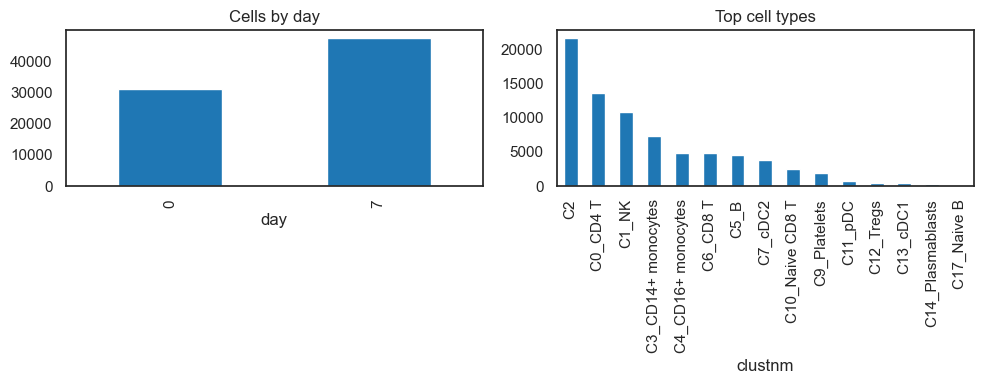
ct_counts = adata.obs["clustnm"].value_counts().head(15)
fig, axes = plt.subplots(1, 2, figsize=(10, 4))
eday_counts.plot(kind="bar", ax=axes[0], title="Cells by day")
ct_counts.plot(kind="bar", ax=axes[1], title="Top cell types")
plt.tight_layout(); plt.show()
Days: [0 7]
Participants: 6
Cell types: 18
Participants per day:
day
0    6
7    6
Name: pt_id, dtype: int64
3. Trial Design and Timepoint Strategy#
[5]:
# Ensure log1p CPM
if "log1p_cpm" not in adata.layers:
    adata = st.add_log1p_cpm_layer(adata, counts_layer="counts", out_layer="log1p_cpm")
# Standardize metadata
adata.obs["visit"] = adata.obs["day"].astype(str)
adata.obs["participant_id"] = adata.obs["pt_id"].astype(str)
adata.obs["cell_type"] = adata.obs["clustnm"].astype(str)
visit_col = "visit"
visits = [v for v in ["0", "7"] if v in adata.obs[visit_col].unique()]
# Participant-level pairing
participant_summary = (
    adata.obs.groupby("participant_id")[visit_col].apply(set).reset_index()
)
participant_summary["has_day0"] = participant_summary[visit_col].apply(lambda x: "0" in x)
participant_summary["has_day7"] = participant_summary[visit_col].apply(lambda x: "7" in x)
participant_summary["is_paired"] = participant_summary["has_day0"] & participant_summary["has_day7"]
paired_ids = set(participant_summary.loc[participant_summary["is_paired"], "participant_id"])
n_paired = len(paired_ids)
print(f"Paired participants (0 vs 7): {n_paired}")
# Analysis subset: paired participants only
adata_analysis = adata[adata.obs["participant_id"].isin(paired_ids)].copy()
print(f"Analysis subset cells: {adata_analysis.n_obs}")
# Covariates (if available)
candidate_covariates = ["age", "sex", "batch", "site"]
covariates = [c for c in candidate_covariates if c in adata.obs.columns]
print("Covariates available (not modeled here):", covariates)

# Design object for a SINGLE-ARM longitudinal study.
# All participants received vaccine — there is no control arm.
# arm_col=None tells sctrial this is a single-arm design.
# Analyses use within_arm_comparison() for paired pre→post inference,
# NOT between-arm DiD.
design = st.TrialDesign(
    participant_col="participant_id",
    visit_col=visit_col,
    arm_col=None,           # Single-arm study — no arm column
    celltype_col="cell_type",
)

# Run diagnostics
print("\n--- Trial Diagnostics ---")
diag = st.diagnose_trial_data(adata_analysis, design)
display(diag)

design
Paired participants (0 vs 7): 6
Analysis subset cells: 78456
Covariates available (not modeled here): []

--- Trial Diagnostics ---
{'n_cells': 78456,
 'n_genes': 15640,
 'n_participants': 6,
 'n_visits': 2,
 'visits': ['0', '7'],
 'paired_participants': {('0', '7'): 6},
 'cells_per_participant_visit_mean': np.float64(6538.0),
 'cells_per_participant_visit_median': np.float64(5345.0),
 'cells_per_participant_visit_min': np.int64(3463),
 'n_celltypes': 18,
 'celltype_distribution': {'C2': 21632,
  'C0_CD4 T': 13633,
  'C1_NK': 10816,
  'C3_CD14+ monocytes': 7308,
  'C4_CD16+ monocytes': 4872,
  'C6_CD8 T': 4861,
  'C5_B': 4597,
  'C7_cDC2': 3876,
  'C10_Naive CD8 T': 2464,
  'C9_Platelets': 1871,
  'C11_pDC': 741,
  'C12_Tregs': 465,
  'C13_cDC1': 388,
  'C14_Plasmablasts': 294,
  'C17_Naive B': 222,
  'C16_NK T': 204,
  'C15_HPCs': 182,
  'C8_CD14+BDCA1+PD-L1+ cells': 30},
 'warnings': [],
 'recommendations': ['Sample size is small; use bootstrap inference (use_bootstrap=True)']}
[5]:
TrialDesign(participant_col='participant_id', visit_col='visit', arm_col=None, arm_treated='Treated', arm_control='Control', celltype_col='cell_type', crossover_col=None, baseline_visit=None, followup_visit=None)
3.1 Exploratory plots of cell types per visit#
[6]:
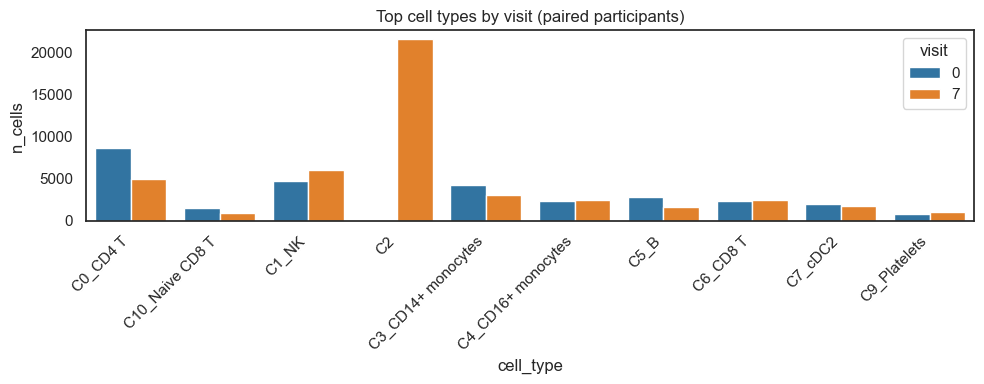
ct_visit = (
    adata_analysis.obs
    .groupby([design.celltype_col, design.visit_col], observed=True)
    .size()
    .reset_index(name="n_cells")
)
top_ct = adata_analysis.obs[design.celltype_col].value_counts().head(10).index
ct_visit_top = ct_visit[ct_visit[design.celltype_col].isin(top_ct)].copy()
plt.figure(figsize=(10, 4))
sns.barplot(data=ct_visit_top, x=design.celltype_col, y="n_cells", hue=design.visit_col)
plt.title("Top cell types by visit (paired participants)")
plt.xticks(rotation=45, ha="right")
plt.tight_layout(); plt.show()
4. UMAPs of All Cell Types#
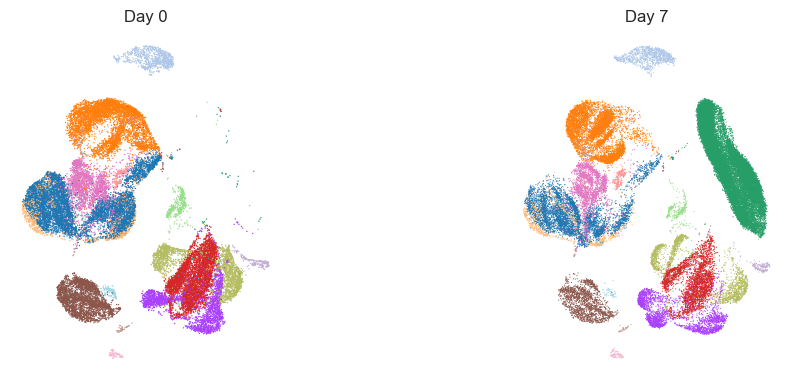
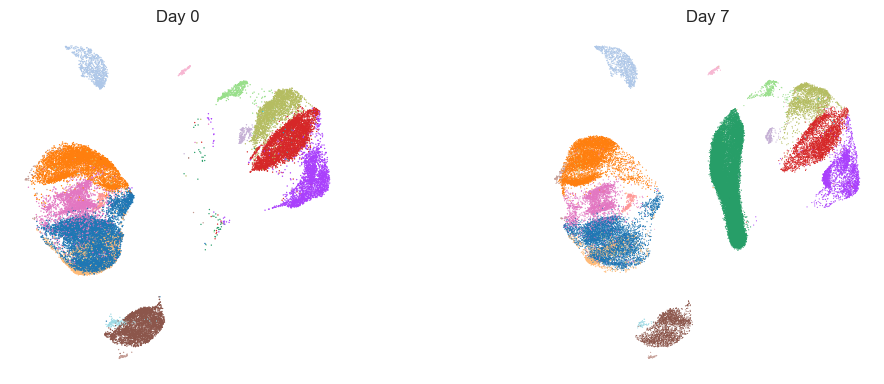
Here, we explore global structure across all cell types to understand broad immune landscape changes.
[7]:
# Compute UMAP on log1p CPM if missing
adata_umap = adata_analysis.copy()
adata_umap.X = adata_umap.layers["log1p_cpm"].copy()
if "X_umap" not in adata_umap.obsm:
    sc.pp.pca(adata_umap)
    sc.pp.neighbors(adata_umap)
    sc.tl.umap(adata_umap)
sc.pl.umap(
    adata_umap,
    color=design.celltype_col,
    legend_loc="right margin",
    title="All cell types (paired participants)",
)
# Stratified UMAPs by visit
fig, axes = plt.subplots(1, len(visits), figsize=(12, 4))
if len(visits) == 1:
    axes = [axes]
for i, vis in enumerate(visits):
    sub = adata_umap[adata_umap.obs[design.visit_col] == vis].copy()
    ax = axes[i]
    if sub.n_obs > 0:
        sc.pl.umap(sub, color=design.celltype_col, ax=ax, show=False, legend_loc=None, frameon=False)
        ax.set_title(f"Day {vis}")
        ax.set_aspect('equal')
    else:
        ax.set_axis_off()
plt.tight_layout(); plt.show()
/Users/vasanthakup/Documents/Work/umcAmsterdam/sctrial/sctrial_venv/lib/python3.13/site-packages/tqdm/auto.py:21: TqdmWarning: IProgress not found. Please update jupyter and ipywidgets. See https://ipywidgets.readthedocs.io/en/stable/user_install.html
  from .autonotebook import tqdm as notebook_tqdm
5. Module Scoring and Gene Panel#
Here, we define biologically motivated signatures and a focused gene panel for downstream within‑arm testing.
[8]:
available = set(adata_analysis.var_names)

# Canonical 19-signature dictionary (matches manuscript figures _shared.py)
gene_signatures = {
    "Cytotoxic T Cell Activity": [
        "GZMB", "GZMA", "GZMH", "GZMK", "GZMM", "PRF1", "GNLY", "NKG7",
        "KLRK1", "KLRD1", "KLRG1", "FASLG", "IFNG", "CST7", "CCL5",
        "CX3CR1", "FGFBP2",
    ],
    "T Cell Exhaustion": [
        "TOX", "TOX2", "PDCD1", "HAVCR2", "LAG3", "TIGIT", "ENTPD1",
        "CXCL13", "LAYN", "CD38", "PRDM1", "BATF", "NR4A2", "NR4A3",
        "CD160", "CD244",
    ],
    "Checkpoint Receptors": [
        "PDCD1", "CTLA4", "LAG3", "HAVCR2", "TIGIT", "BTLA", "CD160",
        "CD244", "CD96",
    ],
    "Type I Interferon": [
        "ISG15", "IFI27", "IFI44", "IFI44L", "IFI35", "MX1", "OAS1",
        "OASL", "IFIT2", "IFIT3", "IFITM3", "RSAD2", "LY6E", "USP18",
        "IRF7", "STAT2", "ISG20", "BST2", "HERC6", "EPSTI1", "SAMD9L",
        "PARP9", "RTP4", "LGALS3BP", "CMPK2",
    ],
    "Type II Interferon": [
        "STAT1", "IRF1", "GBP1", "GBP2", "GBP4", "GBP5", "CXCL9",
        "CXCL10", "CXCL11", "IDO1", "SOCS1", "SOCS3", "JAK2", "UBE2L6",
        "WARS", "IL18BP", "VCAM1", "SERPING1", "FGL2", "IFI30",
    ],
    "Memory T Cell": [
        "IL7R", "TCF7", "LEF1", "CCR7", "SELL", "CD27", "CD28", "ID3",
        "REL", "FOXP1", "BACH2", "MYB", "FOXO1", "KLF2", "S1PR1",
    ],
    "T Cell Activation": [
        "CD69", "CD44", "IL2RA", "ICOS", "TNFRSF4", "TNFRSF9", "CD40LG",
        "EGR1", "EGR2", "EGR3", "NR4A1", "MYC", "IL2RB", "IRF4",
        "TNFRSF18",
    ],
    "Inflammatory Response": [
        "IL1B", "IL6", "TNF", "CXCL8", "CCL2", "CCL3", "CCL4", "NFKB1",
        "NLRP3", "CASP1", "CXCL1", "CXCL2", "CXCL3", "CCL20", "PTGS2",
        "IL1A", "TNFAIP3", "NFKBIA", "IL18", "S100A8", "S100A9",
    ],
    "Antigen Presentation": [
        "HLA-A", "HLA-B", "HLA-C", "B2M", "TAP1", "TAP2", "TAPBP",
        "NLRC5", "PSMB8", "PSMB9", "PSMB10", "CIITA", "CD74", "HLA-DRA",
        "HLA-DRB1", "HLA-DPA1", "HLA-DPB1", "HLA-DQA1", "HLA-DMA",
        "HLA-DMB", "CTSS",
    ],
    "Cell Proliferation": [
        "MKI67", "TOP2A", "PCNA", "CDK1", "CCNB1", "CCNA2", "MCM2",
        "MCM7", "TYMS", "BIRC5", "UBE2C", "CENPF", "CENPE", "CCNB2",
        "RRM2", "HMGB2", "TPX2", "NUSAP1", "CKS2", "AURKA", "CKS1B",
        "STMN1",
    ],
    "Regulatory T Cell": [
        "FOXP3", "IKZF2", "IKZF4", "IL2RA", "CTLA4", "TNFRSF18",
        "TNFRSF4", "TNFRSF9", "TIGIT", "ENTPD1", "LRRC32", "RTKN2",
        "CCR8", "LAYN", "IL1R2",
    ],
    "NK Cell Activity": [
        "FCGR3A", "NCR1", "NCR3", "NCR2", "KLRF1", "KLRC1", "KLRC2",
        "KLRD1", "KLRB1", "IL2RB", "TBX21", "GZMM", "SH2D1B", "GNLY",
        "NKG7",
    ],
    "Apoptosis": [
        "BAX", "BAK1", "BID", "BCL2L11", "BBC3", "PMAIP1", "CASP3",
        "CASP7", "CASP8", "CASP9", "FAS", "TNFRSF10B", "DIABLO", "APAF1",
        "CDKN1A", "GADD45A", "GADD45B", "DDIT3", "FDXR", "BTG2",
    ],
    "Oxidative Stress Response": [
        "NFE2L2", "HMOX1", "NQO1", "GCLC", "GCLM", "GSR", "SOD1", "SOD2",
        "CAT", "GPX1", "TXN", "TXNRD1", "PRDX1", "PRDX2", "SRXN1",
        "G6PD", "GPX4", "GLRX", "SLC7A11",
    ],
    "Humoral Plasma Cell": [
        "MS4A1", "CD79A", "CD79B", "CD19", "CD37", "BANK1", "TCL1A",
        "FCRL5", "POU2AF1", "MZB1", "JCHAIN", "XBP1", "PRDM1", "DERL3",
        "SDC1", "TNFRSF17", "SEC11C", "HERPUD1", "FKBP11", "SLAMF7",
        "IGHM", "IGHG1", "IGKC", "IGLC2", "FDCSP",
    ],
    "Monocyte Macrophage": [
        "CD14", "CD68", "LYZ", "CSF1R", "AIF1", "TYROBP", "FCER1G",
        "CTSS", "FCGR3A", "ITGAM", "MNDA", "CD163", "MRC1", "MSR1",
        "MARCO", "APOE", "C1QA", "C1QB", "C1QC", "TREM2", "SELENOP",
        "LGALS3", "FCN1", "VCAN", "S100A9",
    ],
    "Tissue-Resident Memory": [
        "ITGAE", "ITGA1", "CXCR6", "ZNF683", "CD101", "RGS1", "RGS2",
        "DUSP6", "RBPJ", "CD69", "ID2", "PRDM1", "NR4A1", "DUSP1",
        "EGR1",
    ],
    "T Follicular Helper": [
        "CXCL13", "CXCR5", "PDCD1", "ICOS", "BCL6", "TOX", "TOX2",
        "IL21", "BTLA", "CD200", "MAF", "ASCL2", "SH2D1A", "CD40LG",
        "TNFRSF4", "BATF",
    ],
    "Hypoxia": [
        "VEGFA", "SLC2A1", "SLC2A3", "HK1", "HK2", "PGK1", "LDHA",
        "ALDOA", "ENO1", "PDK1", "BNIP3L", "NDRG1", "ADM", "ANGPTL4",
        "DDIT4", "PPP1R15A", "ERO1A", "P4HA1", "CA12", "IGFBP3", "PLIN2",
    ],
}

print("Gene set coverage (19 canonical signatures):")
filtered = {}
for name, genes in gene_signatures.items():
    present = [g for g in genes if g in available]
    pct = len(present) / len(genes) * 100 if genes else 0
    status = "OK" if len(present) >= MIN_GENES_FOR_SCORE else "SKIP"
    print(f"  {name}: {len(present)}/{len(genes)} genes ({pct:.0f}%) [{status}]")
    if len(present) >= MIN_GENES_FOR_SCORE:
        filtered[name] = present
if filtered:
    adata_analysis = st.score_gene_sets(
        adata_analysis, filtered, layer="log1p_cpm", method="zmean", prefix="sig_"
    )
    print(f"\nScored {len(filtered)} gene sets using zmean.")
else:
    print(f"\nNo gene sets matched (min_genes={MIN_GENES_FOR_SCORE}); skipping module scoring.")
features = [c for c in adata_analysis.obs.columns if c.startswith("sig_")]
print("Signature score features:", features)
# Panel genes for individual gene analysis
panel_genes_all = [
    # B cell
    "CD79A", "CD79B", "MS4A1", "MZB1", "XBP1",
    # IFN
    "ISG15", "IFI6", "IFIT1", "MX1",
    # Inflammatory
    "S100A8", "S100A9", "LYZ", "VCAN",
    # T cell activation
    "CD69", "CD38", "IL2RA",
    # Cytotoxic
    "GZMB", "PRF1", "NKG7",
]
panel_genes = [g for g in panel_genes_all if g in available]
missing_panel = [g for g in panel_genes_all if g not in available]
print("\nPanel genes (available):", panel_genes)
if missing_panel:
    print("Panel genes missing:", missing_panel)
Gene set coverage (19 canonical signatures):
  Cytotoxic T Cell Activity: 17/17 genes (100%) [OK]
  T Cell Exhaustion: 15/16 genes (94%) [OK]
  Checkpoint Receptors: 9/9 genes (100%) [OK]
  Type I Interferon: 25/25 genes (100%) [OK]
  Type II Interferon: 20/20 genes (100%) [OK]
  Memory T Cell: 15/15 genes (100%) [OK]
  T Cell Activation: 15/15 genes (100%) [OK]
  Inflammatory Response: 21/21 genes (100%) [OK]
  Antigen Presentation: 21/21 genes (100%) [OK]
  Cell Proliferation: 22/22 genes (100%) [OK]
  Regulatory T Cell: 15/15 genes (100%) [OK]
  NK Cell Activity: 14/15 genes (93%) [OK]
  Apoptosis: 20/20 genes (100%) [OK]
  Oxidative Stress Response: 18/19 genes (95%) [OK]
  Humoral Plasma Cell: 24/25 genes (96%) [OK]
  Monocyte Macrophage: 25/25 genes (100%) [OK]
  Tissue-Resident Memory: 15/15 genes (100%) [OK]
  T Follicular Helper: 14/16 genes (88%) [OK]
  Hypoxia: 21/21 genes (100%) [OK]

Scored 19 gene sets using zmean.
Signature score features: ['sig_Cytotoxic T Cell Activity', 'sig_T Cell Exhaustion', 'sig_Checkpoint Receptors', 'sig_Type I Interferon', 'sig_Type II Interferon', 'sig_Memory T Cell', 'sig_T Cell Activation', 'sig_Inflammatory Response', 'sig_Antigen Presentation', 'sig_Cell Proliferation', 'sig_Regulatory T Cell', 'sig_NK Cell Activity', 'sig_Apoptosis', 'sig_Oxidative Stress Response', 'sig_Humoral Plasma Cell', 'sig_Monocyte Macrophage', 'sig_Tissue-Resident Memory', 'sig_T Follicular Helper', 'sig_Hypoxia']

Panel genes (available): ['CD79A', 'CD79B', 'MS4A1', 'MZB1', 'XBP1', 'ISG15', 'IFI6', 'IFIT1', 'MX1', 'S100A8', 'S100A9', 'LYZ', 'VCAN', 'CD69', 'CD38', 'IL2RA', 'GZMB', 'PRF1', 'NKG7']
[9]:
# ============================================================================
# PAIRING VERIFICATION (package helper)
# ============================================================================
print("=" * 60)
print("PAIRING VERIFICATION (based on valid signature scores)")
print("=" * 60)
paired_info = verify_paired_participants(
    adata_analysis.obs,
    visit_col=visit_col,
    visits=visits,
    features=features,
    participant_col="participant_id",
)
VALID_PAIRED_IDS = paired_info["paired_ids"]
N_VALID_PAIRED = paired_info["n_paired"]
print("")
print(f"Participants with valid Day0+Day7 scores for ALL features: {N_VALID_PAIRED}")
print(f"Total participants: {paired_info['n_total']}")
if paired_info["dropped_ids"]:
    print(f"Dropped (missing visit or NaN features): {len(paired_info['dropped_ids'])}")
else:
    print("All paired participants have valid scores ✓")
print("")
print(f"Using {N_VALID_PAIRED} validated paired participants for analyses.")
============================================================
PAIRING VERIFICATION (based on valid signature scores)
============================================================

Participants with valid Day0+Day7 scores for ALL features: 6
Total participants: 6
All paired participants have valid scores ✓

Using 6 validated paired participants for analyses.
6. Within-Arm Comparisons (Participant-Level)#
Here, we run paired within‑participant analyses to determine which module scores change from Day 0 to Day 7.
Bootstrap inference: With only 6 paired participants, cluster-robust asymptotic p-values are anti-conservative. We use
use_bootstrap=True(wild cluster bootstrap-t; Cameron et al. 2008) to obtain reliable p-values, standard errors, and confidence intervals. The bootstrap p-value replaces the analytical p-value as the primary inferential quantity.
[10]:
print("=" * 60)
print("WITHIN-ARM COMPARISONS: MODULE SCORES (Day 0 vs Day 7)")
print("=" * 60)
res_within = pd.DataFrame()
if features and len(visits) == 2:
    ad_sub = adata_analysis[adata_analysis.obs["participant_id"].isin(VALID_PAIRED_IDS)].copy()
    res_within = st.within_arm_comparison(
        ad_sub,
        arm="All",
        features=features,
        design=design,
        visits=tuple(visits),
        aggregate="participant_visit",
        standardize=True,
        use_bootstrap=True,   # Recommended for small n (6 participants)
        n_boot=999,
        seed=SEED,
    )
    if res_within is not None and not res_within.empty:
        # Use package helper for FDR correction
        res_within = ensure_fdr(res_within, p_col="p_time", fdr_col="FDR_time")
        display_cols = [
            "feature", "beta_time", "se_time", "p_time",
            "p_time_boot", "se_time_boot", "ci_lo_boot", "ci_hi_boot",
            "FDR_time", "n_units",
        ]
        display_cols = [c for c in display_cols if c in res_within.columns]
        display(res_within[display_cols].round(4))
        sig = res_within[(res_within["FDR_time"].notna()) & (res_within["FDR_time"] < FDR_ALPHA)]
        if not sig.empty:
            print("")
            print(f"Module score changes (FDR < {FDR_ALPHA}):")
            for _, row in sig.iterrows():
                direction = "increased" if row["beta_time"] > 0 else "decreased"
                print(f"  {row['feature']}: {direction} (beta={row['beta_time']:.3f}, FDR={_fmt_fdr(row['FDR_time'])})")
        else:
            print("")
            print(f"No module scores reached FDR < {FDR_ALPHA}.")
    else:
        print("No within-arm results for module scores.")
else:
    print("Insufficient features or visits for within-arm comparisons.")
print("")
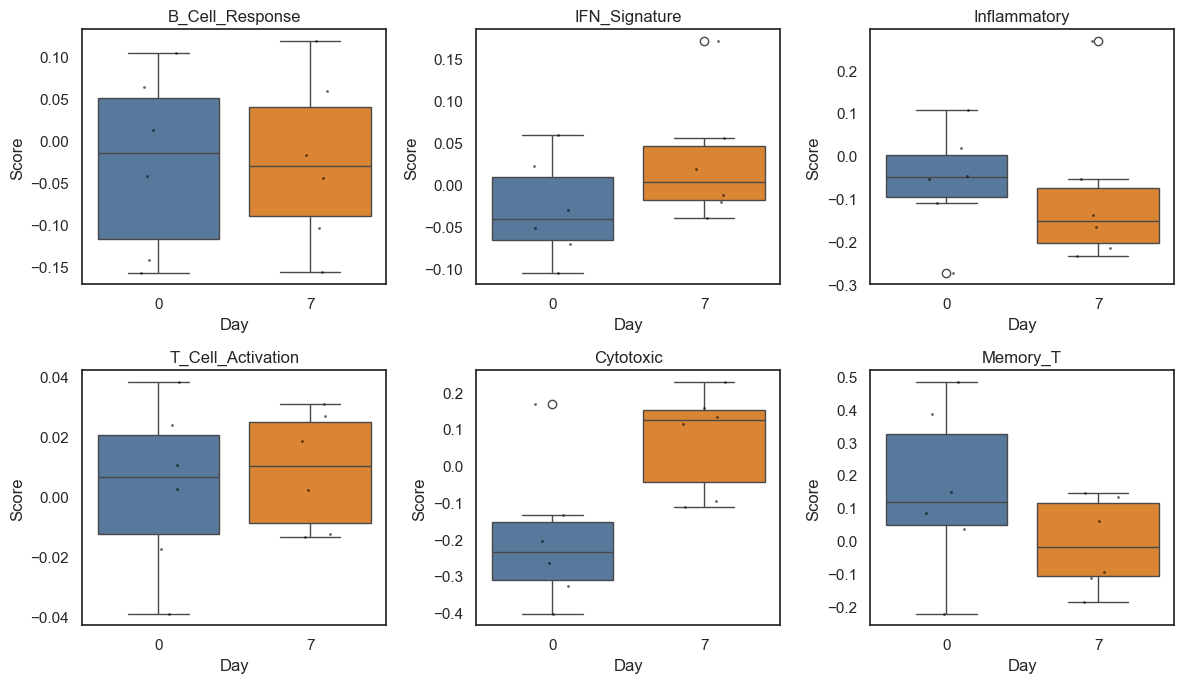
print("Boxplots show participant-level distributions by day; points indicate individual participants.")
# Plot participant-level module scores by day
if features and len(visits) == 2:
    df_plot = (
        adata_analysis.obs
        .groupby(["participant_id", "visit"], observed=True)[features]
        .mean()
        .reset_index()
    )
    n_feats = len(features)
    n_cols = min(3, n_feats)
    n_rows = (n_feats + n_cols - 1) // n_cols
    fig, axes = plt.subplots(n_rows, n_cols, figsize=(4*n_cols, 3.5*n_rows))
    axes = np.array(axes).reshape(-1)
    for i, feat in enumerate(features):
        ax = axes[i]
        sns.boxplot(
            data=df_plot,
            x="visit",
            y=feat,
            hue="visit",
            ax=ax,
            order=visits,
            palette={"0": "#4C78A8", "7": "#F58518"},
            dodge=False,
            linewidth=1,
        )
        sns.stripplot(
            data=df_plot,
            x="visit",
            y=feat,
            ax=ax,
            order=visits,
            color="black",
            size=2,
            alpha=0.6,
            jitter=0.15,
        )
        ax.set_title(feat.replace("sig_", ""))
        ax.set_xlabel("Day")
        ax.set_ylabel("Score")
        if ax.legend_:
            ax.legend_.remove()
    for j in range(i+1, len(axes)):
        axes[j].axis("off")
    plt.tight_layout()
    plt.show()
============================================================
WITHIN-ARM COMPARISONS: MODULE SCORES (Day 0 vs Day 7)
============================================================
/var/folders/xl/pr40r62n3wx54s8_6cgjzg2c0000gt/T/ipykernel_12724/292175458.py:7: UserWarning: Only 6 clusters (participants) available. Cluster-robust standard errors are unreliable with fewer than 10 clusters.
  res_within = st.within_arm_comparison(
/var/folders/xl/pr40r62n3wx54s8_6cgjzg2c0000gt/T/ipykernel_12724/292175458.py:7: UserWarning: Only 6 clusters (participants) available. Cluster-robust standard errors are unreliable with fewer than 10 clusters.
  res_within = st.within_arm_comparison(
/var/folders/xl/pr40r62n3wx54s8_6cgjzg2c0000gt/T/ipykernel_12724/292175458.py:7: UserWarning: Only 6 clusters (participants) available. Cluster-robust standard errors are unreliable with fewer than 10 clusters.
  res_within = st.within_arm_comparison(
/var/folders/xl/pr40r62n3wx54s8_6cgjzg2c0000gt/T/ipykernel_12724/292175458.py:7: UserWarning: Only 6 clusters (participants) available. Cluster-robust standard errors are unreliable with fewer than 10 clusters.
  res_within = st.within_arm_comparison(
/var/folders/xl/pr40r62n3wx54s8_6cgjzg2c0000gt/T/ipykernel_12724/292175458.py:7: UserWarning: Only 6 clusters (participants) available. Cluster-robust standard errors are unreliable with fewer than 10 clusters.
  res_within = st.within_arm_comparison(
/var/folders/xl/pr40r62n3wx54s8_6cgjzg2c0000gt/T/ipykernel_12724/292175458.py:7: UserWarning: Only 6 clusters (participants) available. Cluster-robust standard errors are unreliable with fewer than 10 clusters.
  res_within = st.within_arm_comparison(
/var/folders/xl/pr40r62n3wx54s8_6cgjzg2c0000gt/T/ipykernel_12724/292175458.py:7: UserWarning: Only 6 clusters (participants) available. Cluster-robust standard errors are unreliable with fewer than 10 clusters.
  res_within = st.within_arm_comparison(
/var/folders/xl/pr40r62n3wx54s8_6cgjzg2c0000gt/T/ipykernel_12724/292175458.py:7: UserWarning: Only 6 clusters (participants) available. Cluster-robust standard errors are unreliable with fewer than 10 clusters.
  res_within = st.within_arm_comparison(
/var/folders/xl/pr40r62n3wx54s8_6cgjzg2c0000gt/T/ipykernel_12724/292175458.py:7: UserWarning: Only 6 clusters (participants) available. Cluster-robust standard errors are unreliable with fewer than 10 clusters.
  res_within = st.within_arm_comparison(
/var/folders/xl/pr40r62n3wx54s8_6cgjzg2c0000gt/T/ipykernel_12724/292175458.py:7: UserWarning: Only 6 clusters (participants) available. Cluster-robust standard errors are unreliable with fewer than 10 clusters.
  res_within = st.within_arm_comparison(
/var/folders/xl/pr40r62n3wx54s8_6cgjzg2c0000gt/T/ipykernel_12724/292175458.py:7: UserWarning: Only 6 clusters (participants) available. Cluster-robust standard errors are unreliable with fewer than 10 clusters.
  res_within = st.within_arm_comparison(
/var/folders/xl/pr40r62n3wx54s8_6cgjzg2c0000gt/T/ipykernel_12724/292175458.py:7: UserWarning: Only 6 clusters (participants) available. Cluster-robust standard errors are unreliable with fewer than 10 clusters.
  res_within = st.within_arm_comparison(
/var/folders/xl/pr40r62n3wx54s8_6cgjzg2c0000gt/T/ipykernel_12724/292175458.py:7: UserWarning: Only 6 clusters (participants) available. Cluster-robust standard errors are unreliable with fewer than 10 clusters.
  res_within = st.within_arm_comparison(
/var/folders/xl/pr40r62n3wx54s8_6cgjzg2c0000gt/T/ipykernel_12724/292175458.py:7: UserWarning: Only 6 clusters (participants) available. Cluster-robust standard errors are unreliable with fewer than 10 clusters.
  res_within = st.within_arm_comparison(
/var/folders/xl/pr40r62n3wx54s8_6cgjzg2c0000gt/T/ipykernel_12724/292175458.py:7: UserWarning: Only 6 clusters (participants) available. Cluster-robust standard errors are unreliable with fewer than 10 clusters.
  res_within = st.within_arm_comparison(
/var/folders/xl/pr40r62n3wx54s8_6cgjzg2c0000gt/T/ipykernel_12724/292175458.py:7: UserWarning: Only 6 clusters (participants) available. Cluster-robust standard errors are unreliable with fewer than 10 clusters.
  res_within = st.within_arm_comparison(
/var/folders/xl/pr40r62n3wx54s8_6cgjzg2c0000gt/T/ipykernel_12724/292175458.py:7: UserWarning: Only 6 clusters (participants) available. Cluster-robust standard errors are unreliable with fewer than 10 clusters.
  res_within = st.within_arm_comparison(
/var/folders/xl/pr40r62n3wx54s8_6cgjzg2c0000gt/T/ipykernel_12724/292175458.py:7: UserWarning: Only 6 clusters (participants) available. Cluster-robust standard errors are unreliable with fewer than 10 clusters.
  res_within = st.within_arm_comparison(
/var/folders/xl/pr40r62n3wx54s8_6cgjzg2c0000gt/T/ipykernel_12724/292175458.py:7: UserWarning: Only 6 clusters (participants) available. Cluster-robust standard errors are unreliable with fewer than 10 clusters.
  res_within = st.within_arm_comparison(
| feature | beta_time | se_time | p_time | p_time_boot | se_time_boot | ci_lo_boot | ci_hi_boot | FDR_time | n_units | |
|---|---|---|---|---|---|---|---|---|---|---|
| 0 | sig_Cytotoxic T Cell Activity | 1.2886 | 0.4382 | 0.025 | 0.025 | 0.5767 | 0.2483 | 2.0159 | 0.2375 | 6 |
| 1 | sig_T Cell Exhaustion | 0.5348 | 0.6336 | 0.300 | 0.300 | 0.4280 | -0.4506 | 1.5203 | 0.6333 | 6 |
| 2 | sig_Checkpoint Receptors | 0.6179 | 0.7618 | 0.287 | 0.287 | 0.5085 | -0.4867 | 1.7225 | 0.6333 | 6 |
| 3 | sig_Type I Interferon | 0.8268 | 0.6900 | 0.117 | 0.117 | 0.5135 | -0.1694 | 1.8229 | 0.4864 | 6 |
| 4 | sig_Type II Interferon | 0.1349 | 0.5475 | 0.695 | 0.695 | 0.3307 | -0.6381 | 0.9078 | 0.9006 | 6 |
| 5 | sig_Memory T Cell | -0.8043 | 0.8785 | 0.154 | 0.154 | 0.6392 | -1.8197 | 0.2111 | 0.4877 | 6 |
| 6 | sig_T Cell Activation | -0.6227 | 0.7585 | 0.266 | 0.266 | 0.5420 | -1.4501 | 0.2048 | 0.6333 | 6 |
| 7 | sig_Inflammatory Response | -0.2234 | 0.3309 | 0.379 | 0.379 | 0.2283 | -0.7879 | 0.3412 | 0.6546 | 6 |
| 8 | sig_Antigen Presentation | 0.8333 | 0.6299 | 0.040 | 0.040 | 0.5128 | 0.0000 | 1.6571 | 0.2533 | 6 |
| 9 | sig_Cell Proliferation | 0.7657 | 0.6623 | 0.128 | 0.128 | 0.4965 | -0.3319 | 1.8633 | 0.4864 | 6 |
| 10 | sig_Regulatory T Cell | 0.2037 | 0.7132 | 0.688 | 0.688 | 0.4381 | -0.8730 | 1.2805 | 0.9006 | 6 |
| 11 | sig_NK Cell Activity | 1.1442 | 0.4492 | 0.025 | 0.025 | 0.5266 | 0.1593 | 1.7954 | 0.2375 | 6 |
| 12 | sig_Apoptosis | -0.0700 | 0.6834 | 0.960 | 0.960 | 0.4168 | -0.8979 | 0.7578 | 0.9880 | 6 |
| 13 | sig_Oxidative Stress Response | 0.2509 | 0.6090 | 0.622 | 0.622 | 0.3749 | -0.5859 | 1.0877 | 0.9006 | 6 |
| 14 | sig_Humoral Plasma Cell | 0.2759 | 0.3945 | 0.348 | 0.348 | 0.2619 | -0.3146 | 0.8664 | 0.6546 | 6 |
| 15 | sig_Monocyte Macrophage | 0.5195 | 1.0860 | 0.765 | 0.765 | 0.7030 | -0.7468 | 1.7857 | 0.9084 | 6 |
| 16 | sig_Tissue-Resident Memory | -0.2779 | 0.5777 | 0.711 | 0.711 | 0.3744 | -0.9250 | 0.3693 | 0.9006 | 6 |
| 17 | sig_T Follicular Helper | 0.0800 | 0.8488 | 0.941 | 0.941 | 0.5137 | -1.1531 | 1.3132 | 0.9880 | 6 |
| 18 | sig_Hypoxia | -0.0853 | 0.7438 | 0.988 | 0.988 | 0.4553 | -0.9949 | 0.8243 | 0.9880 | 6 |
Module score changes (FDR < 0.25):
  sig_Cytotoxic T Cell Activity: increased (beta=1.289, FDR=0.238)
  sig_NK Cell Activity: increased (beta=1.144, FDR=0.238)

Boxplots show participant-level distributions by day; points indicate individual participants.
Module-Score Pseudobulk by Cell Type (Within-Arm)#
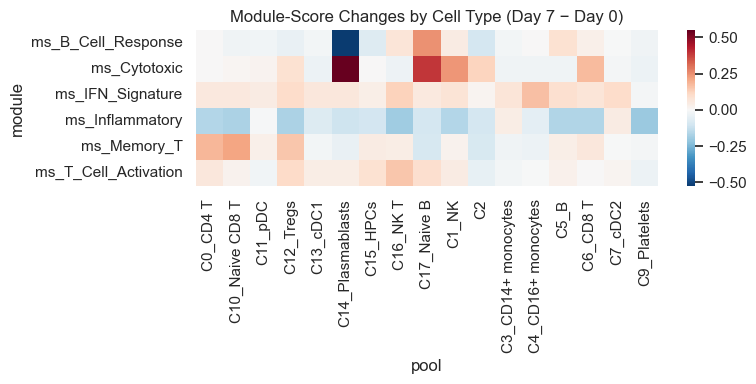
Here, we aggregate module scores to participant×visit×cell_type (pseudobulk) and test paired Day 0→Day 7 changes within the vaccinated arm for each cell type.
[11]:
if features and len(visits) == 2:
    pb_mod = st.module_score_pseudobulk(
        adata_analysis,
        module_cols=features,
        design=design,
        visits=tuple(visits),
        pool_col="cell_type",
        min_cells_per_group=5,
    )
    res_mod_ct = st.module_score_within_arm_by_pool(
        pb_mod,
        design=design,
        visits=tuple(visits),
        min_paired=3,
        fdr_within="module",
    )
    if not res_mod_ct.empty:
        display(res_mod_ct.sort_values("p_time").head(20))
        pivot = res_mod_ct.pivot(index="module", columns="pool", values="mean_delta")
        plt.figure(figsize=(8, max(4, 0.35*len(pivot))))
        sns.heatmap(pivot, cmap="RdBu_r", center=0)
        plt.title("Module-Score Changes by Cell Type (Day 7 − Day 0)")
        plt.tight_layout()
        plt.show()
    else:
        print("No valid pseudobulk module-score results for cell types.")
else:
    print("Skipping pseudobulk module-score analysis: insufficient features or visits.")
| pool | module | mean_delta | p_time | n_units | FDR_time | |
|---|---|---|---|---|---|---|
| 51 | C11_pDC | sig_T Cell Activation | -0.055481 | 0.03125 | 6 | 0.177083 |
| 247 | C5_B | sig_Antigen Presentation | 0.083956 | 0.06250 | 5 | 0.177083 |
| 258 | C5_B | sig_Oxidative Stress Response | 0.043831 | 0.06250 | 5 | 0.106250 |
| 182 | C1_NK | sig_Oxidative Stress Response | 0.116826 | 0.06250 | 5 | 0.106250 |
| 181 | C1_NK | sig_NK Cell Activity | 0.315391 | 0.06250 | 5 | 0.354167 |
| 63 | C12_Tregs | sig_Hypoxia | 0.063585 | 0.06250 | 5 | 0.132812 |
| 177 | C1_NK | sig_Hypoxia | 0.088562 | 0.06250 | 5 | 0.132812 |
| 262 | C5_B | sig_T Follicular Helper | 0.062958 | 0.06250 | 5 | 0.212500 |
| 264 | C5_B | sig_Type I Interferon | 0.074297 | 0.06250 | 5 | 0.132812 |
| 266 | C6_CD8 T | sig_Antigen Presentation | 0.065149 | 0.06250 | 5 | 0.177083 |
| 175 | C1_NK | sig_Cytotoxic T Cell Activity | 0.267165 | 0.06250 | 5 | 0.354167 |
| 269 | C6_CD8 T | sig_Checkpoint Receptors | 0.090656 | 0.06250 | 5 | 0.177083 |
| 270 | C6_CD8 T | sig_Cytotoxic T Cell Activity | 0.168289 | 0.06250 | 5 | 0.354167 |
| 271 | C6_CD8 T | sig_Humoral Plasma Cell | 0.041735 | 0.06250 | 5 | 0.531250 |
| 174 | C1_NK | sig_Checkpoint Receptors | 0.154767 | 0.06250 | 5 | 0.177083 |
| 272 | C6_CD8 T | sig_Hypoxia | 0.083226 | 0.06250 | 5 | 0.132812 |
| 173 | C1_NK | sig_Cell Proliferation | 0.031105 | 0.06250 | 5 | 0.212500 |
| 99 | C14_Plasmablasts | sig_Cytotoxic T Cell Activity | 0.521276 | 0.06250 | 5 | 0.354167 |
| 276 | C6_CD8 T | sig_NK Cell Activity | 0.123374 | 0.06250 | 5 | 0.354167 |
| 256 | C5_B | sig_Monocyte Macrophage | -0.049689 | 0.06250 | 5 | 0.212500 |
7. Gene Expression Within-Arm (Panel Genes)#
Here, we test targeted panel genes for within‑arm changes using participant‑level aggregation.
[12]:
print("=" * 60)
print("WITHIN-ARM COMPARISONS: PANEL GENES (Day 0 vs Day 7)")
print("=" * 60)
res_genes = pd.DataFrame()
if panel_genes and len(visits) == 2:
    ad_sub = adata_analysis[adata_analysis.obs["participant_id"].isin(VALID_PAIRED_IDS)].copy()
    res_genes = st.within_arm_comparison(
        ad_sub,
        arm="All",
        features=panel_genes,
        design=design,
        visits=tuple(visits),
        aggregate="participant_visit",
        standardize=True,
        layer="log1p_cpm",
        use_bootstrap=True,   # Recommended for small n (6 participants)
        n_boot=999,
        seed=SEED,
    )
    if res_genes is not None and not res_genes.empty:
        # Use package helper for FDR correction
        res_genes = ensure_fdr(res_genes, p_col="p_time", fdr_col="FDR_time")
        display_cols = [
            "feature", "beta_time", "se_time", "p_time",
            "p_time_boot", "se_time_boot", "ci_lo_boot", "ci_hi_boot",
            "FDR_time", "n_units",
        ]
        display_cols = [c for c in display_cols if c in res_genes.columns]
        display(res_genes[display_cols].round(4))
        sig = res_genes[(res_genes["FDR_time"].notna()) & (res_genes["FDR_time"] < FDR_ALPHA)]
        if not sig.empty:
            print("")
            print(f"Panel genes with significant changes (FDR < {FDR_ALPHA}):")
            for _, row in sig.iterrows():
                direction = "increased" if row["beta_time"] > 0 else "decreased"
                print(f"  {row['feature']}: {direction} (beta={row['beta_time']:.3f}, FDR={_fmt_fdr(row['FDR_time'])})")
        else:
            print("")
            print(f"No panel genes reached FDR < {FDR_ALPHA}.")
    else:
        print("No within-arm results for panel genes.")
else:
    print("No panel genes available or missing visits.")
print("")
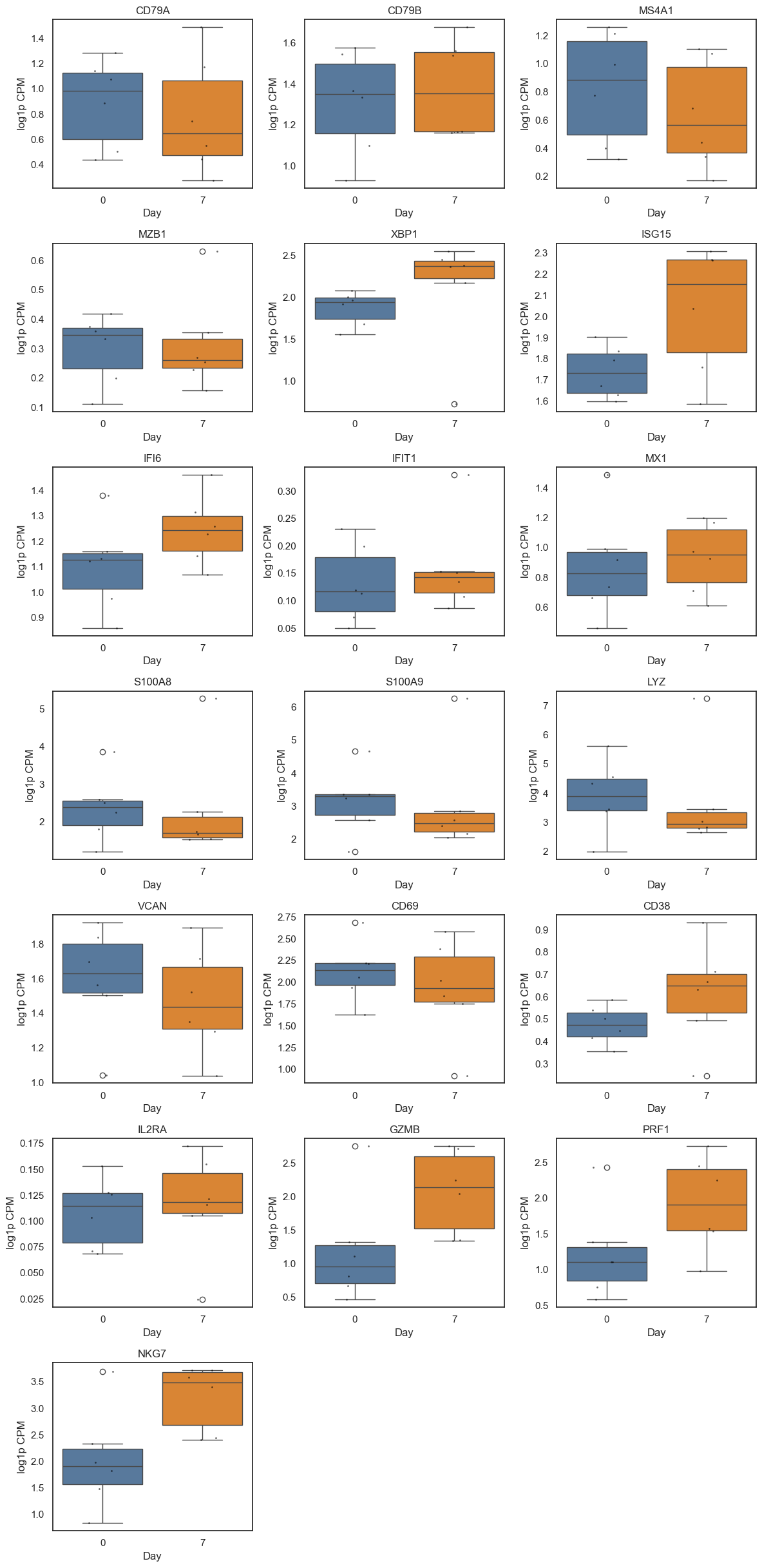
print("Boxplots show participant-level log1p CPM by day; points indicate individual participants.")
# Plot participant-level panel genes by day (log1p CPM)
if panel_genes and len(visits) == 2:
    df_expr = adata_analysis.obs[["participant_id", "visit"]].copy()
    for g in panel_genes:
        df_expr[g] = st.extract_gene_vector(adata_analysis, g, layer="log1p_cpm")
    df_plot = (
        df_expr
        .groupby(["participant_id", "visit"], observed=True)[panel_genes]
        .mean()
        .reset_index()
    )
    n_feats = len(panel_genes)
    n_cols = min(3, n_feats)
    n_rows = (n_feats + n_cols - 1) // n_cols
    fig, axes = plt.subplots(n_rows, n_cols, figsize=(4*n_cols, 3.5*n_rows))
    axes = np.array(axes).reshape(-1)
    for i, feat in enumerate(panel_genes):
        ax = axes[i]
        sns.boxplot(
            data=df_plot,
            x="visit",
            y=feat,
            hue="visit",
            ax=ax,
            order=visits,
            palette={"0": "#4C78A8", "7": "#F58518"},
            dodge=False,
            linewidth=1,
        )
        sns.stripplot(
            data=df_plot,
            x="visit",
            y=feat,
            ax=ax,
            order=visits,
            color="black",
            size=2,
            alpha=0.6,
            jitter=0.15,
        )
        ax.set_title(feat)
        ax.set_xlabel("Day")
        ax.set_ylabel("log1p CPM")
        if ax.legend_:
            ax.legend_.remove()
    for j in range(i+1, len(axes)):
        axes[j].axis("off")
    plt.tight_layout()
    plt.show()
============================================================
WITHIN-ARM COMPARISONS: PANEL GENES (Day 0 vs Day 7)
============================================================
/var/folders/xl/pr40r62n3wx54s8_6cgjzg2c0000gt/T/ipykernel_12724/4144594531.py:7: UserWarning: Only 6 clusters (participants) available. Cluster-robust standard errors are unreliable with fewer than 10 clusters.
  res_genes = st.within_arm_comparison(
/var/folders/xl/pr40r62n3wx54s8_6cgjzg2c0000gt/T/ipykernel_12724/4144594531.py:7: UserWarning: Only 6 clusters (participants) available. Cluster-robust standard errors are unreliable with fewer than 10 clusters.
  res_genes = st.within_arm_comparison(
/var/folders/xl/pr40r62n3wx54s8_6cgjzg2c0000gt/T/ipykernel_12724/4144594531.py:7: UserWarning: Only 6 clusters (participants) available. Cluster-robust standard errors are unreliable with fewer than 10 clusters.
  res_genes = st.within_arm_comparison(
/var/folders/xl/pr40r62n3wx54s8_6cgjzg2c0000gt/T/ipykernel_12724/4144594531.py:7: UserWarning: Only 6 clusters (participants) available. Cluster-robust standard errors are unreliable with fewer than 10 clusters.
  res_genes = st.within_arm_comparison(
/var/folders/xl/pr40r62n3wx54s8_6cgjzg2c0000gt/T/ipykernel_12724/4144594531.py:7: UserWarning: Only 6 clusters (participants) available. Cluster-robust standard errors are unreliable with fewer than 10 clusters.
  res_genes = st.within_arm_comparison(
/var/folders/xl/pr40r62n3wx54s8_6cgjzg2c0000gt/T/ipykernel_12724/4144594531.py:7: UserWarning: Only 6 clusters (participants) available. Cluster-robust standard errors are unreliable with fewer than 10 clusters.
  res_genes = st.within_arm_comparison(
/var/folders/xl/pr40r62n3wx54s8_6cgjzg2c0000gt/T/ipykernel_12724/4144594531.py:7: UserWarning: Only 6 clusters (participants) available. Cluster-robust standard errors are unreliable with fewer than 10 clusters.
  res_genes = st.within_arm_comparison(
/var/folders/xl/pr40r62n3wx54s8_6cgjzg2c0000gt/T/ipykernel_12724/4144594531.py:7: UserWarning: Only 6 clusters (participants) available. Cluster-robust standard errors are unreliable with fewer than 10 clusters.
  res_genes = st.within_arm_comparison(
/var/folders/xl/pr40r62n3wx54s8_6cgjzg2c0000gt/T/ipykernel_12724/4144594531.py:7: UserWarning: Only 6 clusters (participants) available. Cluster-robust standard errors are unreliable with fewer than 10 clusters.
  res_genes = st.within_arm_comparison(
/var/folders/xl/pr40r62n3wx54s8_6cgjzg2c0000gt/T/ipykernel_12724/4144594531.py:7: UserWarning: Only 6 clusters (participants) available. Cluster-robust standard errors are unreliable with fewer than 10 clusters.
  res_genes = st.within_arm_comparison(
/var/folders/xl/pr40r62n3wx54s8_6cgjzg2c0000gt/T/ipykernel_12724/4144594531.py:7: UserWarning: Only 6 clusters (participants) available. Cluster-robust standard errors are unreliable with fewer than 10 clusters.
  res_genes = st.within_arm_comparison(
/var/folders/xl/pr40r62n3wx54s8_6cgjzg2c0000gt/T/ipykernel_12724/4144594531.py:7: UserWarning: Only 6 clusters (participants) available. Cluster-robust standard errors are unreliable with fewer than 10 clusters.
  res_genes = st.within_arm_comparison(
/var/folders/xl/pr40r62n3wx54s8_6cgjzg2c0000gt/T/ipykernel_12724/4144594531.py:7: UserWarning: Only 6 clusters (participants) available. Cluster-robust standard errors are unreliable with fewer than 10 clusters.
  res_genes = st.within_arm_comparison(
/var/folders/xl/pr40r62n3wx54s8_6cgjzg2c0000gt/T/ipykernel_12724/4144594531.py:7: UserWarning: Only 6 clusters (participants) available. Cluster-robust standard errors are unreliable with fewer than 10 clusters.
  res_genes = st.within_arm_comparison(
/var/folders/xl/pr40r62n3wx54s8_6cgjzg2c0000gt/T/ipykernel_12724/4144594531.py:7: UserWarning: Only 6 clusters (participants) available. Cluster-robust standard errors are unreliable with fewer than 10 clusters.
  res_genes = st.within_arm_comparison(
/var/folders/xl/pr40r62n3wx54s8_6cgjzg2c0000gt/T/ipykernel_12724/4144594531.py:7: UserWarning: Only 6 clusters (participants) available. Cluster-robust standard errors are unreliable with fewer than 10 clusters.
  res_genes = st.within_arm_comparison(
/var/folders/xl/pr40r62n3wx54s8_6cgjzg2c0000gt/T/ipykernel_12724/4144594531.py:7: UserWarning: Only 6 clusters (participants) available. Cluster-robust standard errors are unreliable with fewer than 10 clusters.
  res_genes = st.within_arm_comparison(
/var/folders/xl/pr40r62n3wx54s8_6cgjzg2c0000gt/T/ipykernel_12724/4144594531.py:7: UserWarning: Only 6 clusters (participants) available. Cluster-robust standard errors are unreliable with fewer than 10 clusters.
  res_genes = st.within_arm_comparison(
/var/folders/xl/pr40r62n3wx54s8_6cgjzg2c0000gt/T/ipykernel_12724/4144594531.py:7: UserWarning: Only 6 clusters (participants) available. Cluster-robust standard errors are unreliable with fewer than 10 clusters.
  res_genes = st.within_arm_comparison(
| feature | beta_time | se_time | p_time | p_time_boot | se_time_boot | ci_lo_boot | ci_hi_boot | FDR_time | n_units | |
|---|---|---|---|---|---|---|---|---|---|---|
| 0 | CD79A | -0.2144 | 0.4500 | 0.572 | 0.572 | 0.2805 | -1.2647 | 0.4948 | 0.9057 | 6 |
| 1 | CD79B | 0.3413 | 0.2993 | 0.111 | 0.111 | 0.2223 | -0.0857 | 0.7684 | 0.3013 | 6 |
| 2 | MS4A1 | -0.4411 | 0.2317 | 0.102 | 0.102 | 0.2259 | -0.9130 | 0.0307 | 0.3013 | 6 |
| 3 | MZB1 | 0.1605 | 0.5370 | 0.698 | 0.698 | 0.3281 | -0.6446 | 0.8228 | 0.9334 | 6 |
| 4 | XBP1 | 0.4776 | 0.6685 | 0.338 | 0.338 | 0.4393 | -0.6300 | 1.5852 | 0.6422 | 6 |
| 5 | ISG15 | 1.2238 | 0.3872 | 0.025 | 0.025 | 0.5260 | 0.4279 | 1.9762 | 0.1583 | 6 |
| 6 | IFI6 | 0.8093 | 0.1471 | 0.025 | 0.025 | 0.3352 | 0.5589 | 1.0741 | 0.1583 | 6 |
| 7 | IFIT1 | 0.4003 | 0.5250 | 0.261 | 0.261 | 0.3439 | -0.4464 | 1.2471 | 0.5510 | 6 |
| 8 | MX1 | 0.2257 | 0.3559 | 0.374 | 0.374 | 0.2283 | -0.4036 | 0.9937 | 0.6460 | 6 |
| 9 | S100A8 | 0.0192 | 1.1211 | 1.000 | 1.000 | 0.6871 | -1.5854 | 1.4600 | 1.0000 | 6 |
| 10 | S100A9 | -0.0248 | 1.1591 | 0.988 | 0.988 | 0.7096 | -1.6609 | 1.6113 | 1.0000 | 6 |
| 11 | LYZ | -0.1066 | 1.1658 | 0.874 | 0.874 | 0.7117 | -1.8138 | 1.6007 | 0.9768 | 6 |
| 12 | VCAN | -0.2949 | 1.1511 | 0.747 | 0.747 | 0.7110 | -2.4253 | 1.2187 | 0.9334 | 6 |
| 13 | CD69 | -0.4584 | 1.0823 | 0.682 | 0.682 | 0.6973 | -1.9404 | 1.0236 | 0.9334 | 6 |
| 14 | CD38 | 0.7915 | 0.7624 | 0.136 | 0.136 | 0.5452 | -0.4147 | 1.9977 | 0.3230 | 6 |
| 15 | IL2RA | 0.1889 | 0.9749 | 0.786 | 0.786 | 0.5980 | -1.7384 | 2.1162 | 0.9334 | 6 |
| 16 | GZMB | 1.0559 | 0.6822 | 0.086 | 0.086 | 0.6030 | -0.0303 | 2.1422 | 0.3013 | 6 |
| 17 | PRF1 | 0.9794 | 0.4015 | 0.025 | 0.025 | 0.4573 | 0.2039 | 1.6478 | 0.1583 | 6 |
| 18 | NKG7 | 1.1977 | 0.7179 | 0.071 | 0.071 | 0.6608 | 0.0000 | 2.3954 | 0.3013 | 6 |
Panel genes with significant changes (FDR < 0.25):
  ISG15: increased (beta=1.224, FDR=0.158)
  IFI6: increased (beta=0.809, FDR=0.158)
  PRF1: increased (beta=0.979, FDR=0.158)

Boxplots show participant-level log1p CPM by day; points indicate individual participants.
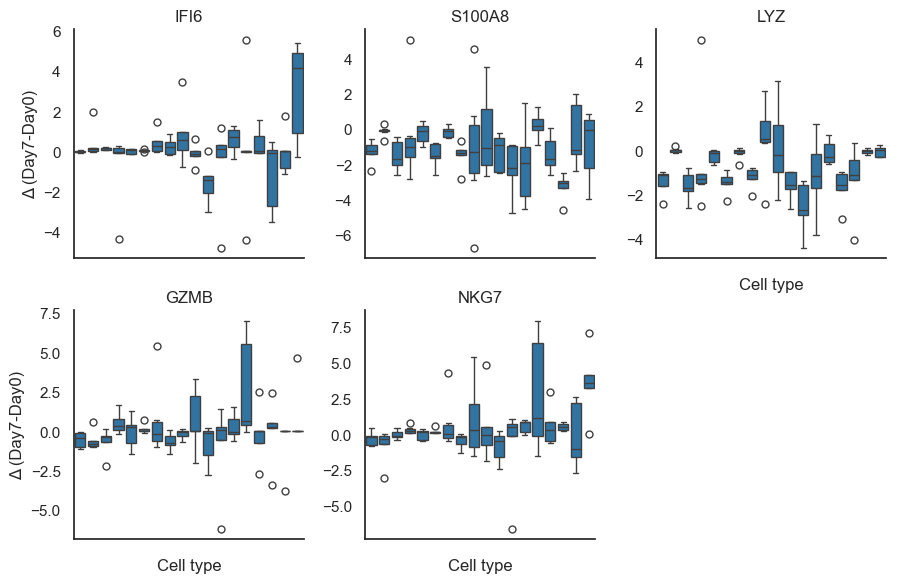
8. Pseudobulk Within-Arm (Panel Genes)#
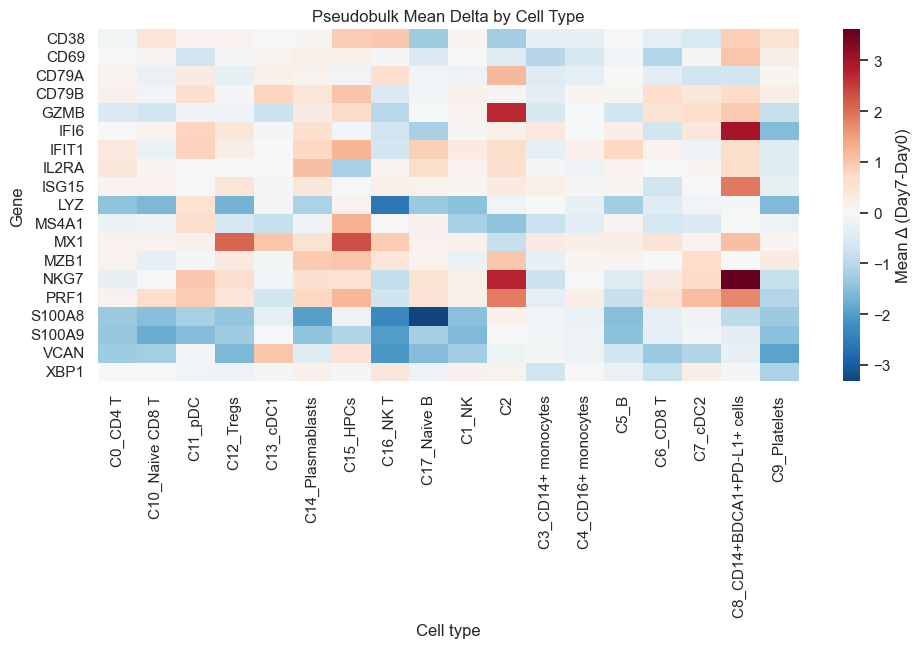
Here, we aggregate counts to pseudobulk profiles and quantify gene‑level shifts by cell type.
Exploratory only: With permissive thresholds (
min_cells_per_group=5,min_paired=3), many cell-type pools have very few paired observations (n≈5), producing discrete p-value distributions and unstable estimates. Treat these as hypothesis-generating, not confirmatory.
[13]:
# Note: scipy.stats.wilcoxon warns 'Sample size too small for normal approximation'
# when n <= 20, but uses exact p-values internally — the results are correct.
import warnings as _w
_w.filterwarnings('ignore', message='Sample size too small', category=UserWarning)

from scipy.stats import wilcoxon
if panel_genes and n_paired >= MIN_PAIRED and len(visits) == 2:
    # Use package helper for pseudobulk within-arm analysis
    pb, pb_deltas = st.pseudobulk_within_arm(
        adata_analysis,
        genes=panel_genes,
        participant_col="participant_id",
        visit_col=design.visit_col,
        visits=visits,
        celltype_col=design.celltype_col,
        counts_layer="counts",
        min_paired=MIN_PAIRED,
    )
    if not pb.empty:
        print("Pseudobulk paired deltas with Wilcoxon signed-rank test (panel genes × cell type):")
        display(pb.sort_values(["p_time"]).head(30))
        sig = pb[(pb["FDR_time"].notna()) & (pb["FDR_time"] < FDR_ALPHA)]
        if not sig.empty:
            print("")
            print(f"Significant pseudobulk changes (FDR < {FDR_ALPHA}):")
            for _, row in sig.iterrows():
                direction = "↑" if row["mean_delta"] > 0 else "↓"
                print(f"  {row['celltype']} - {row['feature']}: {direction} (delta={row['mean_delta']:.3f}, FDR={_fmt_fdr(row['FDR_time'])})")
    else:
        print("No pseudobulk results generated.")
    # Pseudobulk heatmap (mean delta by cell type × gene)
    if not pb.empty:
        sns.set_style("white")
        pivot = pb.pivot(index="feature", columns="celltype", values="mean_delta")
        plt.figure(figsize=(10, max(4, 0.35*len(pivot))))
        ax = plt.gca()
        sns.heatmap(
            pivot,
            cmap="RdBu_r",
            center=0,
            cbar_kws={"label": "Mean Δ (Day7-Day0)"},
            linewidths=0,
            linecolor="none",
        )
        ax.set_axisbelow(False)
        plt.title("Pseudobulk Mean Delta by Cell Type")
        plt.xlabel("Cell type")
        plt.ylabel("Gene")
        plt.tight_layout()
        plt.show()
    # Distribution plots for top genes (by absolute mean delta)
    if not pb.empty and not pb_deltas.empty:
        top_genes = (
            pb.assign(abs_delta=pb["mean_delta"].abs())
            .sort_values("abs_delta", ascending=False)
            .head(6)["feature"].unique()
        )
        plot_df = pb_deltas[pb_deltas["feature"].isin(top_genes)].copy()
        if not plot_df.empty:
            g = sns.catplot(
                data=plot_df,
                x="celltype",
                y="delta",
                col="feature",
                kind="box",
                col_wrap=3,
                sharey=False,
                height=3,
            )
            g.set_titles("{col_name}")
            g.set_xticklabels(rotation=45, ha="right")
            g.set_axis_labels("Cell type", "Δ (Day7-Day0)")
            plt.tight_layout()
            plt.show()
else:
    print("Insufficient paired participants for pseudobulk.")
/Users/vasanthakup/Documents/Work/umcAmsterdam/sctrial/sctrial_venv/lib/python3.13/site-packages/scipy/stats/_wilcoxon.py:178: RuntimeWarning: invalid value encountered in scalar divide
  z = (r_plus - mn) / se
/Users/vasanthakup/Documents/Work/umcAmsterdam/sctrial/sctrial_venv/lib/python3.13/site-packages/scipy/stats/_wilcoxon.py:178: RuntimeWarning: invalid value encountered in scalar divide
  z = (r_plus - mn) / se
/Users/vasanthakup/Documents/Work/umcAmsterdam/sctrial/sctrial_venv/lib/python3.13/site-packages/scipy/stats/_wilcoxon.py:178: RuntimeWarning: invalid value encountered in scalar divide
  z = (r_plus - mn) / se
Pseudobulk paired deltas with Wilcoxon signed-rank test (panel genes × cell type):
/Users/vasanthakup/Documents/Work/umcAmsterdam/sctrial/sctrial_venv/lib/python3.13/site-packages/scipy/stats/_wilcoxon.py:178: RuntimeWarning: invalid value encountered in scalar divide
  z = (r_plus - mn) / se
/Users/vasanthakup/Documents/Work/umcAmsterdam/sctrial/sctrial_venv/lib/python3.13/site-packages/scipy/stats/_wilcoxon.py:178: RuntimeWarning: invalid value encountered in scalar divide
  z = (r_plus - mn) / se
| celltype | feature | n_units | mean_delta | median_delta | p_time | FDR_time | |
|---|---|---|---|---|---|---|---|
| 74 | C6_CD8 T | PRF1 | 6 | 0.548281 | 0.352451 | 0.03125 | 0.362288 |
| 75 | C6_CD8 T | NKG7 | 6 | 0.296983 | 0.189454 | 0.03125 | 0.362288 |
| 69 | C6_CD8 T | VCAN | 6 | -1.334576 | -1.385715 | 0.03125 | 0.362288 |
| 27 | C3_CD14+ monocytes | MX1 | 6 | 0.301871 | 0.225520 | 0.03125 | 0.362288 |
| 32 | C3_CD14+ monocytes | CD69 | 6 | -1.042964 | -0.946489 | 0.03125 | 0.362288 |
| 113 | C1_NK | NKG7 | 5 | 0.209747 | 0.122444 | 0.06250 | 0.362288 |
| 114 | C7_cDC2 | CD79A | 6 | -0.700714 | -0.599609 | 0.06250 | 0.362288 |
| 49 | C10_Naive CD8 T | LYZ | 5 | -1.617291 | -1.729764 | 0.06250 | 0.362288 |
| 48 | C10_Naive CD8 T | S100A9 | 5 | -1.781619 | -1.684003 | 0.06250 | 0.362288 |
| 47 | C10_Naive CD8 T | S100A8 | 5 | -1.522718 | -1.711392 | 0.06250 | 0.362288 |
| 238 | C14_Plasmablasts | S100A9 | 5 | -1.425896 | -0.836746 | 0.06250 | 0.362288 |
| 44 | C10_Naive CD8 T | IFI6 | 5 | 0.124808 | 0.149484 | 0.06250 | 0.362288 |
| 135 | C5_B | MS4A1 | 5 | 0.100942 | 0.104866 | 0.06250 | 0.362288 |
| 302 | C17_Naive B | PRF1 | 5 | 0.484833 | 0.567189 | 0.06250 | 0.362288 |
| 141 | C5_B | MX1 | 5 | 0.267979 | 0.235982 | 0.06250 | 0.362288 |
| 36 | C3_CD14+ monocytes | PRF1 | 6 | -0.362479 | -0.425572 | 0.06250 | 0.362288 |
| 46 | C10_Naive CD8 T | MX1 | 5 | 0.160142 | 0.127109 | 0.06250 | 0.362288 |
| 112 | C1_NK | PRF1 | 5 | 0.197452 | 0.113769 | 0.06250 | 0.362288 |
| 107 | C1_NK | VCAN | 5 | -1.237192 | -1.319447 | 0.06250 | 0.362288 |
| 106 | C1_NK | LYZ | 5 | -1.469975 | -1.444261 | 0.06250 | 0.362288 |
| 105 | C1_NK | S100A9 | 5 | -1.584973 | -1.708566 | 0.06250 | 0.362288 |
| 104 | C1_NK | S100A8 | 5 | -1.492757 | -1.522200 | 0.06250 | 0.362288 |
| 58 | C6_CD8 T | CD79B | 6 | 0.673069 | 0.305295 | 0.06250 | 0.362288 |
| 98 | C1_NK | MZB1 | 5 | -0.260559 | -0.223154 | 0.06250 | 0.362288 |
| 97 | C1_NK | MS4A1 | 5 | -1.192343 | -1.182017 | 0.06250 | 0.362288 |
| 96 | C1_NK | CD79B | 5 | 0.191311 | 0.126330 | 0.06250 | 0.362288 |
| 90 | C4_CD16+ monocytes | CD38 | 5 | -0.329611 | -0.229651 | 0.06250 | 0.362288 |
| 89 | C4_CD16+ monocytes | CD69 | 5 | -0.606386 | -0.824426 | 0.06250 | 0.362288 |
| 87 | C4_CD16+ monocytes | LYZ | 5 | -0.265302 | -0.114227 | 0.06250 | 0.362288 |
| 270 | C12_Tregs | XBP1 | 5 | -0.203194 | -0.202877 | 0.06250 | 0.362288 |
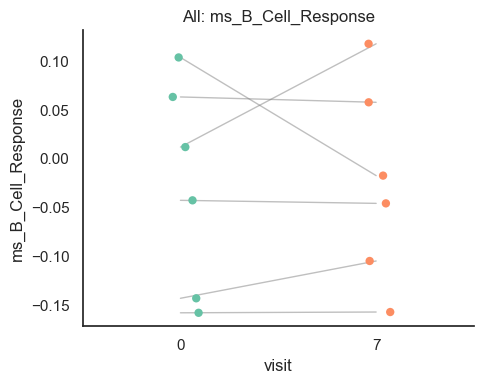
9. Trial Interaction Plot (Single Arm)#
Here, we visualize paired trajectories to interpret direction and magnitude of change.
Note: The plot below shows trajectories for the first module score (
features[0]). Change the index to visualize other modules.
[14]:
if features and len(visits) == 2:
    fig, ax = plt.subplots(1, 1, figsize=(5, 4))
    st.plot_within_arm_comparison(
        adata_analysis,
        arm="All",
        feature=features[0],
        design=design,
        visits=tuple(visits),
        plot_type="paired",
        ax=ax,
    )
    plt.tight_layout(); plt.show()
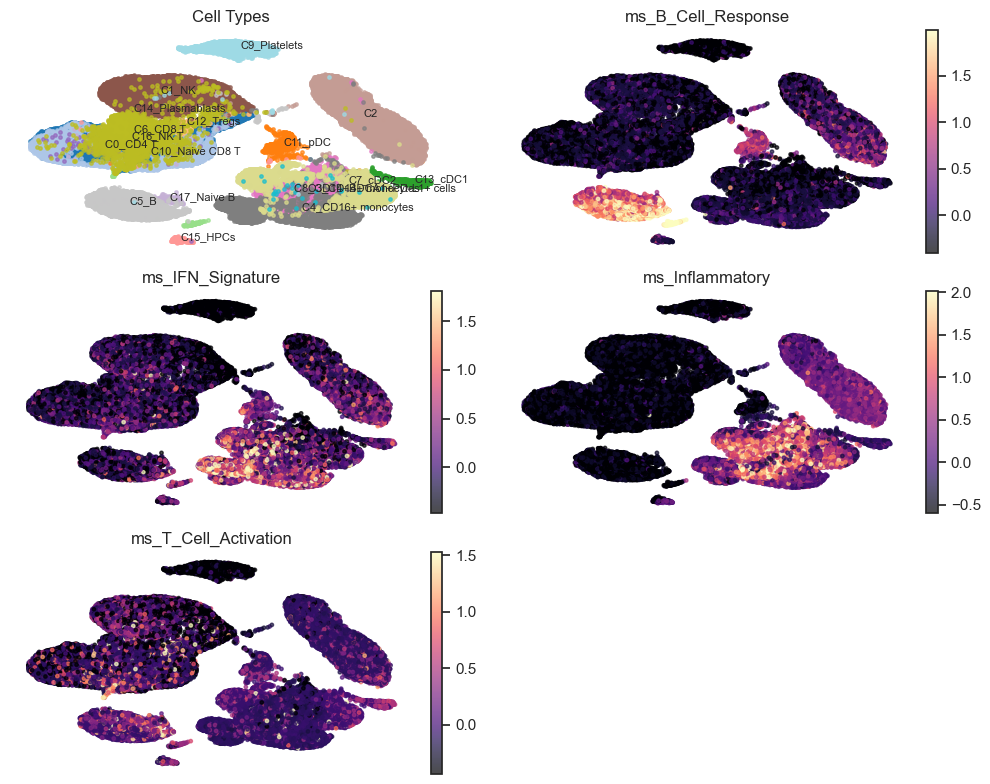
10. Trial UMAP Panel for a Module Score#
Here, we overlay a module score on the UMAP to localize signal to specific cell populations.
[15]:
if features:
    modules = features[:4]
    if "X_umap" not in adata_analysis.obsm:
        # Ensure UMAP is computed on log1p_cpm (same as Section 4)
        adata_analysis.X = adata_analysis.layers["log1p_cpm"].copy()
        sc.pp.pca(adata_analysis)
        sc.pp.neighbors(adata_analysis)
        sc.tl.umap(adata_analysis)
    fig = st.plot_module_umap_panel(
        adata_analysis,
        module_cols=modules,
        celltype_col="cell_type",
        umap_key="X_umap",
        n_cols=2,
        figsize=(10, 8),
        point_size=6,
        alpha=0.7,
    )
    plt.show()
else:
    print("No module scores available for UMAP panel.")
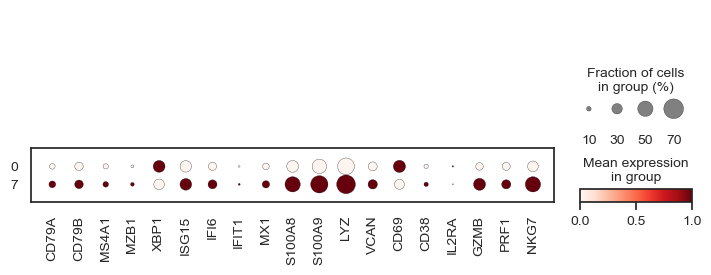
11. Dotplot of Panel Genes#
Here, we summarize gene expression patterns across visits (Day 0 vs Day 7) in a compact dotplot.
[16]:
if panel_genes:
    sc.pl.dotplot(
        adata_analysis,
        panel_genes,
        groupby=design.visit_col,
        standard_scale="var",
        use_raw=False,
    )
12. Advanced Statistical Analyses#
Statistical modules for within-arm longitudinal studies:
Effect sizes: Cohen’s d for paired within-arm changes
Power analysis: Current power and sample size planning
Effective sample size: Accounting for cell-level clustering
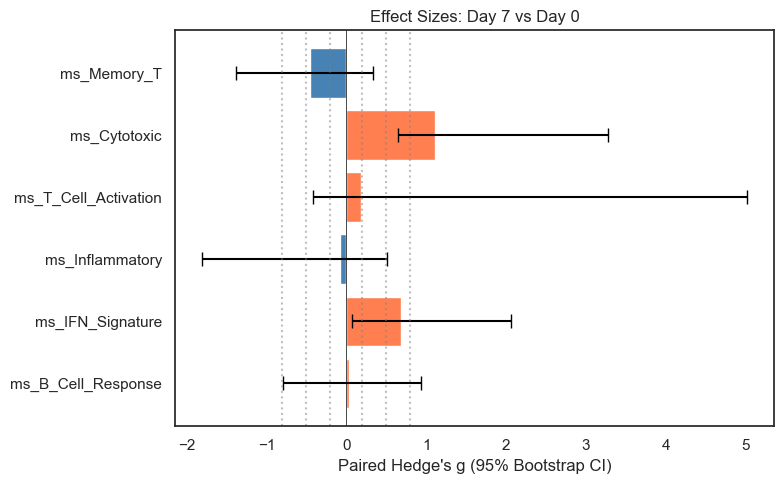
12.1 Effect Sizes for Within-Arm Changes#
For within-arm paired studies, paired effect sizes quantify the magnitude of change from baseline.
[17]:
print("=" * 60)
print("EFFECT SIZE ANALYSIS (Within-Arm)")
print("=" * 60)
if features and len(visits) == 2:
    # Aggregate to participant-visit level
    df_agg = (
        adata_analysis.obs[adata_analysis.obs["participant_id"].isin(VALID_PAIRED_IDS)]
        .groupby(["participant_id", "visit"], observed=True)[features]
        .mean()
        .reset_index()
    )

    effect_results = []
    for feat in features:
        # Pivot to wide format
        wide = df_agg.pivot(index="participant_id", columns="visit", values=feat)

        if visits[0] not in wide.columns or visits[1] not in wide.columns:
            continue

        wide = wide.dropna()
        pre_vals = wide[visits[0]].values
        post_vals = wide[visits[1]].values

        if len(pre_vals) >= 3:
            # Paired effect size: standardized mean of within-subject differences
            delta = post_vals - pre_vals
            sd_delta = delta.std(ddof=1)
            d_paired = delta.mean() / sd_delta if sd_delta > 0 else np.nan

            # Hedge's correction for small-sample bias (paired df = n-1)
            n = len(delta)
            j = 1 - 3 / (4 * (n - 1) - 1) if n > 2 else 1.0
            g_paired = d_paired * j if not np.isnan(d_paired) else np.nan

            # Bootstrap CI for paired effect size
            rng = np.random.default_rng(SEED)
            boot_ds = []
            for _ in range(999):
                idx = rng.choice(n, size=n, replace=True)
                d_boot = delta[idx]
                sd_b = d_boot.std(ddof=1)
                boot_ds.append(d_boot.mean() / sd_b * j if sd_b > 0 else np.nan)
            boot_ds = np.array(boot_ds)
            boot_ds = boot_ds[np.isfinite(boot_ds)]
            ci_low = np.percentile(boot_ds, 2.5) if len(boot_ds) > 0 else np.nan
            ci_high = np.percentile(boot_ds, 97.5) if len(boot_ds) > 0 else np.nan

            effect_results.append({
                "feature": feat,
                "mean_delta": delta.mean(),
                "d_paired": d_paired,
                "g_paired": g_paired,
                "ci_lower": ci_low,
                "ci_upper": ci_high,
                "n_paired": len(pre_vals),
            })

    if effect_results:
        df_effect = pd.DataFrame(effect_results)

        print("\nEffect sizes for Day 0 → Day 7 changes:")
        print("  d_paired: standardized within-subject change (delta_mean / sd_delta)")
        print("  g_paired: bias-corrected paired effect size (Hedge's J correction)")
        print("")
        display(df_effect.round(3))

        # Visualize
        fig, ax = plt.subplots(figsize=(8, 5))
        y_pos = np.arange(len(df_effect))

        ax.barh(y_pos, df_effect["g_paired"], xerr=[
            df_effect["g_paired"] - df_effect["ci_lower"],
            df_effect["ci_upper"] - df_effect["g_paired"]
        ], capsize=5, color=["coral" if g > 0 else "steelblue" for g in df_effect["g_paired"]])
        ax.axvline(0, color="black", linewidth=0.5)
        ax.set_yticks(y_pos)
        ax.set_yticklabels(df_effect["feature"])
        ax.set_xlabel("Paired Hedge's g (95% Bootstrap CI)")
        ax.set_title("Effect Sizes: Day 7 vs Day 0")

        # Reference lines
        for thresh in [-0.8, -0.5, -0.2, 0.2, 0.5, 0.8]:
            ax.axvline(thresh, color="gray", linestyle=":", alpha=0.5)

        plt.tight_layout()
        plt.show()
else:
    print("Effect size analysis requires paired visits.")
============================================================
EFFECT SIZE ANALYSIS (Within-Arm)
============================================================

Effect sizes for Day 0 → Day 7 changes:
  d_paired: standardized within-subject change (delta_mean / sd_delta)
  g_paired: bias-corrected paired effect size (Hedge's J correction)
| feature | mean_delta | d_paired | g_paired | ci_lower | ci_upper | n_paired | |
|---|---|---|---|---|---|---|---|
| 0 | sig_Cytotoxic T Cell Activity | 0.219 | 1.781 | 1.500 | 0.917 | 6.142 | 6 |
| 1 | sig_T Cell Exhaustion | 0.045 | 0.511 | 0.430 | -0.204 | 3.474 | 6 |
| 2 | sig_Checkpoint Receptors | 0.052 | 0.491 | 0.414 | -0.210 | 4.903 | 6 |
| 3 | sig_Type I Interferon | 0.055 | 0.726 | 0.611 | -0.057 | 2.338 | 6 |
| 4 | sig_Type II Interferon | 0.008 | 0.149 | 0.126 | -0.467 | 1.467 | 6 |
| 5 | sig_Memory T Cell | -0.125 | -0.554 | -0.467 | -1.135 | 0.191 | 6 |
| 6 | sig_T Cell Activation | -0.046 | -0.497 | -0.419 | -1.057 | 0.197 | 6 |
| 7 | sig_Inflammatory Response | -0.009 | -0.409 | -0.344 | -1.097 | 0.508 | 6 |
| 8 | sig_Antigen Presentation | 0.075 | 0.801 | 0.675 | 0.314 | 1.720 | 6 |
| 9 | sig_Cell Proliferation | 0.028 | 0.700 | 0.590 | -0.093 | 4.817 | 6 |
| 10 | sig_Regulatory T Cell | 0.009 | 0.173 | 0.146 | -0.447 | 4.454 | 6 |
| 11 | sig_NK Cell Activity | 0.204 | 1.543 | 1.299 | 0.827 | 3.174 | 6 |
| 12 | sig_Apoptosis | -0.008 | -0.062 | -0.052 | -0.610 | 3.176 | 6 |
| 13 | sig_Oxidative Stress Response | 0.028 | 0.249 | 0.210 | -0.377 | 6.175 | 6 |
| 14 | sig_Humoral Plasma Cell | 0.019 | 0.424 | 0.357 | -0.410 | 1.263 | 6 |
| 15 | sig_Monocyte Macrophage | 0.044 | 0.290 | 0.244 | -1.306 | 0.746 | 6 |
| 16 | sig_Tissue-Resident Memory | -0.023 | -0.291 | -0.245 | -0.817 | 0.882 | 6 |
| 17 | sig_T Follicular Helper | 0.005 | 0.057 | 0.048 | -0.511 | 2.580 | 6 |
| 18 | sig_Hypoxia | -0.009 | -0.069 | -0.058 | -0.571 | 2.932 | 6 |
12.2 Power Analysis#
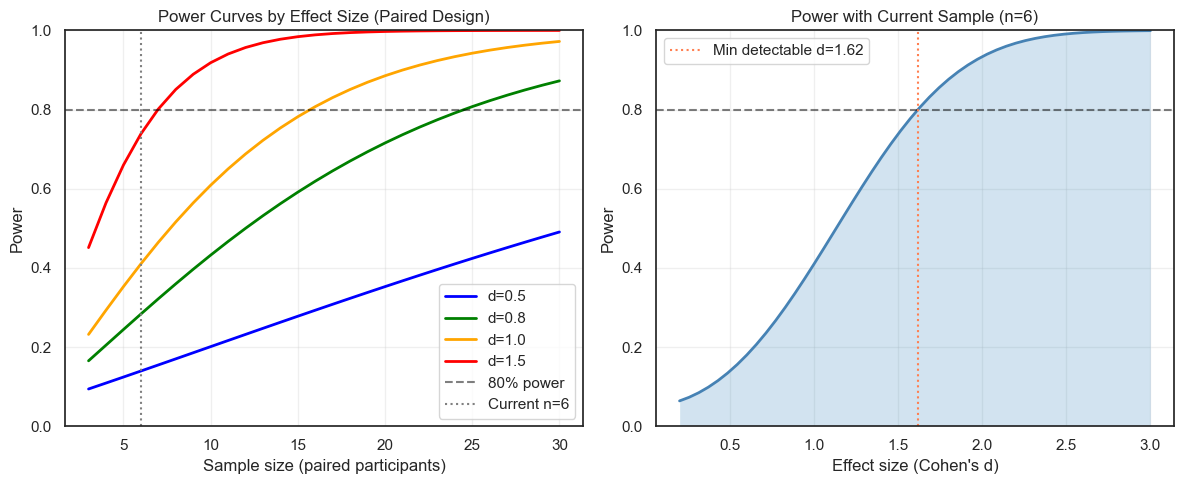
Power analysis for within-arm studies helps plan future studies and understand current study limitations.
[18]:
print("=" * 60)
print("POWER ANALYSIS (Within-Arm Paired Design)")
print("=" * 60)

# Use sctrial's paired power functions (single-arm pre/post design).
# These are the correct functions for a paired study — do NOT use
# power_did() which assumes a two-arm DiD design.

# Current sample size
n_paired = N_VALID_PAIRED
print(f"\nCurrent paired sample size: {n_paired} participants")

# Power for different effect sizes
print(f"\nPower with n={n_paired} paired participants (paired t-test):")
for effect_size in [0.5, 0.8, 1.0, 1.5, 2.0]:
    pwr = st.power_paired(n_participants=n_paired, effect_size=effect_size)
    print(f"  Effect size d={effect_size}: {pwr:.1%} power")

# Sample sizes needed for 80% power
print("\nSample size needed for 80% power (paired design):")
for effect_size in [0.5, 0.8, 1.0, 1.5, 2.0]:
    n_needed = st.sample_size_paired(effect_size=effect_size, power=0.80)
    print(f"  Effect size d={effect_size}: {n_needed} participants")

# Power curve visualization
fig, axes = plt.subplots(1, 2, figsize=(12, 5))

# Power curve across sample sizes
n_range = np.arange(3, 31)
for effect_size, color in [(0.5, "blue"), (0.8, "green"), (1.0, "orange"), (1.5, "red")]:
    powers = [st.power_paired(n_participants=n, effect_size=effect_size) for n in n_range]
    axes[0].plot(n_range, powers, label=f"d={effect_size}", color=color, linewidth=2)
axes[0].axhline(0.8, color="black", linestyle="--", alpha=0.5, label="80% power")
axes[0].axvline(n_paired, color="gray", linestyle=":", label=f"Current n={n_paired}")
axes[0].set_xlabel("Sample size (paired participants)")
axes[0].set_ylabel("Power")
axes[0].set_title("Power Curves by Effect Size (Paired Design)")
axes[0].legend(loc="lower right")
axes[0].set_ylim(0, 1)
axes[0].grid(True, alpha=0.3)

# Power with current sample across effect sizes
effect_range = np.linspace(0.2, 3.0, 50)
power_current = [st.power_paired(n_participants=n_paired, effect_size=e) for e in effect_range]
axes[1].plot(effect_range, power_current, linewidth=2, color="steelblue")
axes[1].axhline(0.8, color="black", linestyle="--", alpha=0.5)
axes[1].fill_between(effect_range, 0, power_current, alpha=0.2)
axes[1].set_xlabel("Effect size (Cohen's d)")
axes[1].set_ylabel("Power")
axes[1].set_title(f"Power with Current Sample (n={n_paired})")
axes[1].set_ylim(0, 1)
axes[1].grid(True, alpha=0.3)

# Mark minimum detectable effect
mde = st.sensitivity_paired(n_participants=n_paired, power=0.80)
axes[1].axvline(mde, color="coral", linestyle=":",
                label=f"Min detectable d={mde:.2f}")
axes[1].legend()
plt.tight_layout()
plt.show()

# Effective sample size
print("\n" + "=" * 60)
print("EFFECTIVE SAMPLE SIZE")
print("=" * 60)
cells_per_participant = adata_analysis.obs.groupby("participant_id").size()
avg_cells = cells_per_participant.mean()
total_cells = adata_analysis.n_obs
n_participants = adata_analysis.obs["participant_id"].nunique()
print(f"\nParticipants: {n_participants}")
print(f"Total cells: {total_cells:,}")
print(f"Average cells per participant: {avg_cells:.0f}")
print("\nDesign effect and effective sample size (cells within participant):")
print("  n_clusters = number of participants (not total cells)")
for icc in [0.01, 0.05, 0.10, 0.20]:
    de = st.design_effect(avg_cells, icc)
    eff_n = st.effective_sample_size(n_participants, avg_cells, icc)
    print(f"  ICC={icc}: Design effect={de:.1f}, Effective n={eff_n:.0f}")
print("\nNote: Participant-level aggregation accounts for clustering automatically.")
============================================================
POWER ANALYSIS (Within-Arm Paired Design)
============================================================

Current paired sample size: 6 participants

Power with n=6 paired participants (paired t-test):
  Effect size d=0.5: 13.9% power
  Effect size d=0.8: 28.3% power
  Effect size d=1.0: 41.0% power
  Effect size d=1.5: 73.8% power
  Effect size d=2.0: 93.4% power

Sample size needed for 80% power (paired design):
  Effect size d=0.5: 63 participants
  Effect size d=0.8: 25 participants
  Effect size d=1.0: 16 participants
  Effect size d=1.5: 7 participants
  Effect size d=2.0: 4 participants
============================================================
EFFECTIVE SAMPLE SIZE
============================================================

Participants: 6
Total cells: 78,456
Average cells per participant: 13076

Design effect and effective sample size (cells within participant):
  n_clusters = number of participants (not total cells)
  ICC=0.01: Design effect=131.8, Effective n=595
  ICC=0.05: Design effect=654.8, Effective n=120
  ICC=0.1: Design effect=1308.5, Effective n=60
  ICC=0.2: Design effect=2616.0, Effective n=30

Note: Participant-level aggregation accounts for clustering automatically.
Pseudobulk Export#
Here we export participant-level pseudobulk expression for downstream analyses.
[19]:
pb = st.pseudobulk_export(
    adata_analysis,
    genes=panel_genes[:5] if panel_genes else adata_analysis.var_names[:5],
    design=design,
    visits=tuple(visits),
    celltype_col=design.celltype_col,
)
print(pb)
display(pb.obs.head())
AnnData object with n_obs × n_vars = 202 × 5
    obs: 'participant_id', 'visit', 'cell_type'
/opt/homebrew/Cellar/python@3.13/3.13.13_1/Frameworks/Python.framework/Versions/3.13/lib/python3.13/functools.py:934: ImplicitModificationWarning: Transforming to str index.
  return dispatch(args[0].__class__)(*args, **kw)
| participant_id | visit | cell_type | |
|---|---|---|---|
| 0 | 2047 | 0 | C0_CD4 T |
| 1 | 2047 | 0 | C3_CD14+ monocytes |
| 2 | 2047 | 0 | C10_Naive CD8 T |
| 3 | 2047 | 0 | C6_CD8 T |
| 4 | 2047 | 0 | C4_CD16+ monocytes |